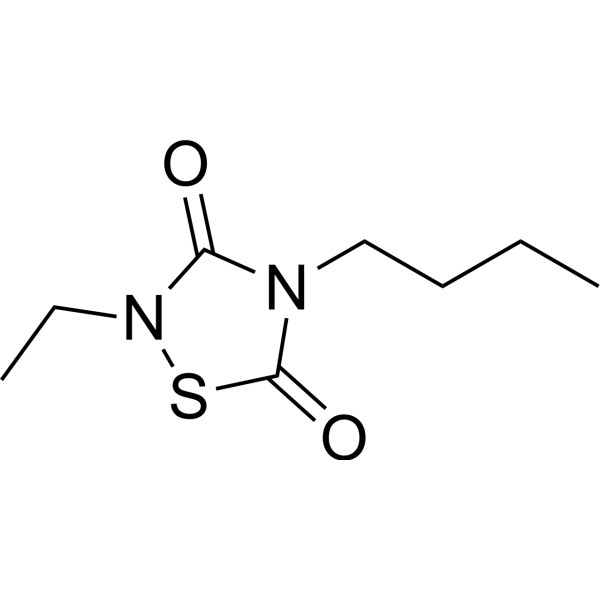
RGS19
RGS19 (also known as GAIP, Gα-interacting protein) is a member of the regulator of G-protein signaling (RGS) family that functions as a GTPase-activating protein (GAP) for heterotrimeric G-protein α subunits, thereby accelerating GTP hydrolysis and terminating GPCR-mediated signaling pathways[1][2]. Mechanistically, RGS19 preferentially interacts with Gαi family proteins, particularly Gαi3, and suppresses downstream Gαi- and Gαq-linked signal transduction, establishing a key regulatory checkpoint in cellular responses to extracellular stimuli[3][4]. Consistent with its role in signal attenuation, RGS19 has been localized to membrane-associated compartments and clathrin-coated vesicles, supporting spatial regulation of G-protein signaling and receptor trafficking processes[5]. In disease-relevant settings, phosphorylation-dependent activation of RGS19 has been reported to enhance its GAP activity and regulate autophagy-related signaling in human colon cancer cells, indicating a functional connection between GPCR regulation and tumor-associated cellular adaptation pathways[6]. Compared with related RGS isoforms such as RGS4, which also exhibits GAP activity toward Gαi proteins, RGS19 is distinguished by its strong association with Gαi3 and its characteristic membrane-targeting mechanisms mediated by lipid modification and protein-protein interactions[2][3][7]. For experimental applications, RGS19 is widely used as a model RGS protein for investigating GPCR desensitization, G-protein deactivation kinetics, and molecular mechanisms governing selective RGS-Gα interactions[1][2][7].
References:
- [1]. Lucidi A, et al. Emergency delivery in pregnancies at high probability of placenta accreta spectrum on prenatal imaging: a systematic review and meta-analysis. Am J Obstet Gynecol MFM. 2024 Oct;6(10):101432. [Content Brief]
- [2]. Berman DM, et al. GAIP and RGS4 are GTPase-activating proteins for the Gi subfamily of G protein alpha subunits. Cell. 1996 Aug 9;86(3):445-52. [Content Brief]
- [3]. De Vries L, et al. GAIP, a protein that specifically interacts with the trimeric G protein G alpha i3, is a member of a protein family with a highly conserved core domain. Proc Natl Acad Sci U S A. 1995 Dec 5;92(25):11916-20. [Content Brief]
- [4]. RGS19 gene information from NCBI.
- [5]. Jin X, et al. Decreases in organ blood flows associated with increases in sublingual PCO2 during hemorrhagic shock. J Appl Physiol (1985). 1998 Dec;85(6):2360-4. [Content Brief]
- [6]. Garinot-Schneider C, et al. Identification of essential amino acid residues in the Sinorhizobium meliloti glucosyltransferase ExoM. J Biol Chem. 2000 Oct 6;275(40):31407-13. [Content Brief]
- [7]. Sakata N, et al. Cytosolic components are required for proteasomal degradation of newly synthesized apolipoprotein B in permeabilized HepG2 cells. J Biol Chem. 1999 Jun 11;274(24):17068-74. [Content Brief]
All Product Categories
-
RGS19 Related Products (2)
Related Products (2)

-
CCG-50014
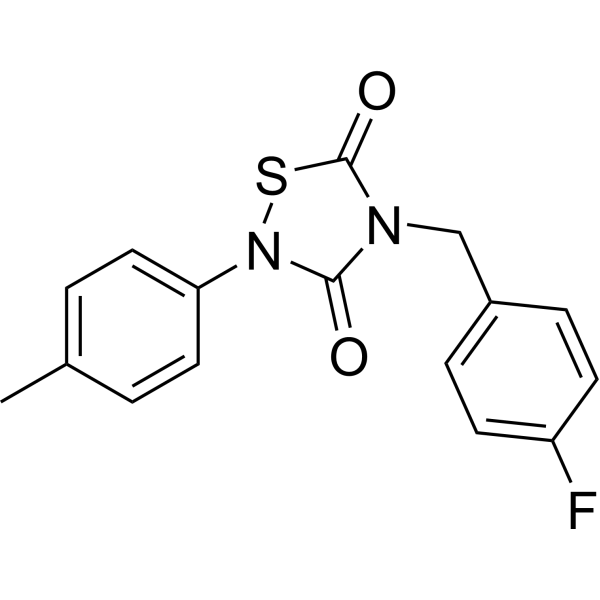 0 ImagesCCG-50014 is the most potent against the regulator of G-protein signaling protein type 4 (RGS4) (IC50 =30 nM) and is >20-fold selective for RGS4 over other RGS proteins. CCG-50014 binds covalently to the RGS, forming an adduct on two cysteine residues located in an allosteric regulatory site. CCG50014, reduces nociceptive responses and enhances opioid-mediated analgesic effects in the mouse formalin test.